
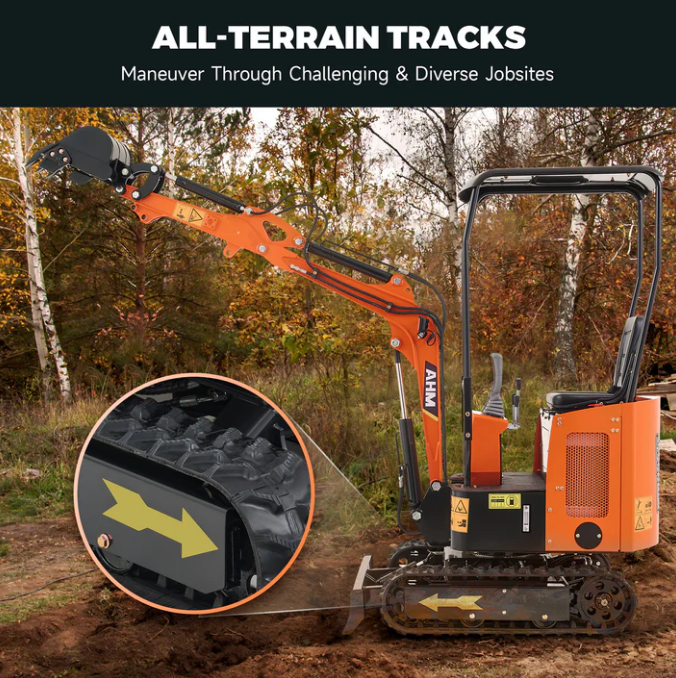
Gravity is a patient coordinator—it’s always waiting for you to make a mistake. When you’re sitting in the cab of an AHM AX-series mini excavator, you have a mountain of hydraulic power at your fingertips. But when you take that power onto a hill, a slope, or uneven terrain, the rules of the game change instantly.
Mini excavators are incredibly stable on flat ground, but because they have a short wheelbase and a high center of gravity, working on an incline requires strategy.
At AHM, your safety is our number one priority. Before you tackle that hillside trench or retaining wall, master these four rules of slope operation.
1. The Golden Rule: Face the Slope
The absolute most dangerous thing you can do in a mini excavator is travel or work perpendicular (sideways) to a steep hill.
- The Right Way:Always drive straight up or straight down a slope. Your tracks should be parallel to the incline.
- The Physics:If you travel sideways across a hill, the center of gravity shifts entirely to the downhill track. One small rock or dip under that track can cause the machine to tip over sideways in the blink of an eye.
2. Keep the Bucket Low and “Forward”
When you are moving on an incline, your bucket isn’t just for dirt—it’s your training wheel and your counterweight.
- Going Uphill:Extend your boom and arm forward, keeping the bucket just a few inches off the ground. If the front of your tracks starts to lift, you can immediately drop the bucket onto the dirt to stabilize the machine.
- Going Downhill:Point the bucket forward and keep it low. If the machine begins to slide, dropping the bucket into the ground acts as an instant emergency brake.
3. The Danger of the 360° Swing
On flat ground, spinning your AHM machine in a full circle is a breeze. On a hill, it can be a trap.
- The Risk:Imagine you are parked facing straight up a hill. Your counterweight (the heavy back of the machine) is safely on the downhill side. If you suddenly swing the cab 180 degrees to dump dirt behind you, that massive counterweight is now swinging to the uphill This suddenly changes your balance point and can cause the back tracks to lift off the ground.
- The Safe Method:If you must swing on a slope, do it slowly and smoothly. Avoid sudden stops or jerks, which create momentum that can pull the machine over.
4. Know Your Limits (The 15/25 Rule)
Every machine has its physical limits, no matter how skilled the operator is. For most compact machinery, we recommend the 15/25 Rule:
- Max Side Slope (15°):Never attempt to operate or travel across a slope greater than 15 degrees sideways.
- Max Up/Down Slope (25°):Never attempt to climb or descend a slope steeper than 25 degrees, even when facing straight under it.
- Note: If the soil is muddy, wet, or rocky, cut those numbers in half. Traction is just as important as the angle.
Slope Safety Checklist
| What to Check | The Safe Standard | Why? |
| Blade Position | Lowered slightly on the downhill side | Acts as an extra anchor to prevent sliding. |
| Seatbelt | Always clicked | If the machine tips, the ROPS (Roll-Over Protective Structure) will save you—but only if you stay inside the cab. |
| Travel Speed | Low gear (Turtle mode) | High gear on a slope can cause sudden track slippage. |
| Engine Oil Level | Full | On steep angles, oil can slosh away from the engine pump. Keep it topped off! |
When in Doubt, Build a Bench
If you absolutely have to dig a trench along a steep hillside, don’t try to fight the angle. Use your AHM excavator to cut a flat bench into the hill first. Dig into the high side, dump the dirt on the low side, and flatten out a platform to sit on. It takes an extra 20 minutes, but it ensures you’re working on a safe, level surface.